Export Packing from China: Cartons, Labels and Pallets
How to pack goods from China for air, sea, rail and express: strong cartons, shipping marks, pallets, ISPM 15 wood rules and packing that cuts freight costs.
Key takeaways
- Use new, strong corrugated cartons sized to the goods, fill the empty space and seal every seam, so cartons survive stacking in a container or an aircraft hold.
- Mark each carton on at least two sides with the order or brand mark, destination, carton number, weights and dimensions, matching the packing list line for line.
- Solid-wood pallets and crates must meet ISPM 15: heat-treated so the wood core reaches 56 °C for 30 minutes, debarked and stamped with the IPPC mark; plywood and other processed wood are exempt.
- Air (÷ 6,000), express (÷ 5,000) and LCL (per CBM) all charge for volume, so a carton sized to the goods can cut the chargeable weight of a shipment by a fifth.
Pack exports from China in new, strong corrugated cartons that fit the goods, fill and seal them so they don't crush, and mark each one with the details on the packing list. Group the cartons on pallets when the shipment goes by air freight, LCL sea or rail, and use treated, ISPM 15-marked wood or a non-wood pallet. Because air, express and LCL all charge for volume, packing tightly is also the easiest saving you can make.
This guide covers cartons, sealing, shipping marks, pallets, the rules for wooden packaging and how packing changes what you pay.
Which cartons should you use?
Use new corrugated cartons. A used carton has already lost much of its stacking strength, and old labels or barcodes on it confuse handlers and scanners. Double-wall (5-ply) cartons suit heavy, dense or fragile goods and long sea voyages, where cartons sit at the bottom of a stack for weeks; single-wall (3-ply) cartons suit light goods packed in many small boxes.
Choose a carton that fits the goods. Empty space lets the top collapse under the cartons above, and an overfilled carton bulges and splits at the seams. Keep each carton to a weight one person can lift safely: it is handled by hand several times between the factory and the final address. For Amazon, the box limits are stricter; our Amazon FBA guide lists them for the US.
How should cartons be filled and sealed?
- Wrap or separate each item so goods don't touch each other or the carton walls; fragile goods need cushioning on every side.
- Put the heaviest items at the bottom and fill every gap with paper, foam or air pillows so nothing moves.
- Seal the centre seam and both edge seams on the top and bottom with strong packing tape (the H pattern).
- For sea freight, bag moisture-sensitive goods and consider desiccant: containers can build up condensation on long voyages.
- Don't rely on straps or string alone; they cut into cartons and don't keep them closed.
What goes on shipping marks and carton labels?
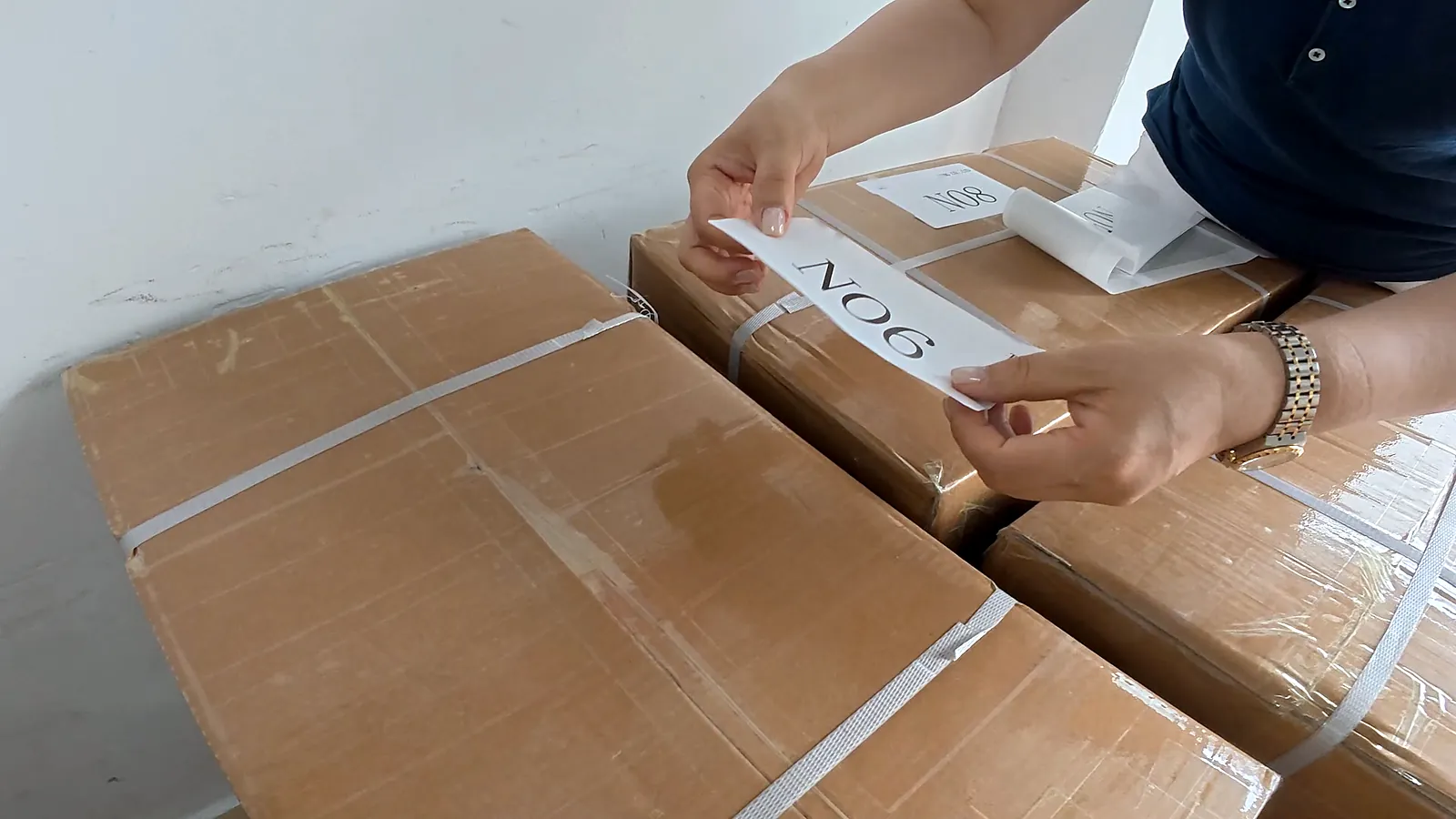
Shipping marks let everyone from the warehouse to the delivery driver identify each carton without opening it. Put them on at least two sides, and make sure the carton numbers, weights and dimensions match the packing list, because customs checks one against the other.
| Mark | Example | Why it matters |
|---|---|---|
| Order or brand mark | PO 2026-118 / ACME | Matches the carton to your order and documents |
| Destination | Hamburg, Germany | Sends the carton to the right place |
| Carton number | 1/50 … 50/50 | Shows that every carton has arrived |
| Gross and net weight | G.W. 12 kg / N.W. 11 kg | Must agree with the packing list |
| Dimensions | 55 × 40 × 35 cm | Used for volume and chargeable weight |
| Country of origin | Made in China | Required on goods or their packaging by many countries |
| Handling marks | This way up, fragile, keep dry | Tells handlers how to stack and move it |
The country-of-origin mark is more than good practice: US law requires imported articles to be marked legibly and permanently with the English name of the country of origin, unless an exception applies. For Amazon shipments, each carton also needs the carton label from your shipment plan.
When should you palletise?
Air consolidations, LCL sea freight and rail shipments are usually palletised: cartons stacked flush on a pallet, stretch-wrapped and strapped travel as one unit and are handled by forklift instead of by hand. Express parcels usually travel as single cartons, so they need strong cartons rather than pallets.
Two pallet sizes cover most shipments from China: the 1,200 × 800 mm Euro pallet (EPAL 1, 144 mm high, with a safe working load of 1,500 kg) for Europe, and the 48 × 40 inch (1,219 × 1,016 mm) pallet common in North America. Stack cartons in columns to the edges without overhang, because an overhanging carton takes the weight of the stack on its unsupported edge, and keep the top flat.
Remember that a pallet adds weight and height, and the volume is measured over the whole loaded pallet. A Euro pallet loaded to 1.5 m in total is 120 × 80 × 150 cm, or 1.44 CBM: an air volumetric weight of 240 kg however much air is left between the cartons.
Do wooden pallets and crates need ISPM 15?
Yes. ISPM 15 is the international standard for packaging made from raw wood, including pallets, crates and dunnage. The wood must be debarked and treated, usually heat-treated so the core of the wood reaches at least 56 °C for 30 continuous minutes, and stamped with the IPPC mark, showing the country code (CN for China), the producer's code and the treatment code, such as HT. Wood packaging without the mark can be refused or destroyed at the border.
Packaging made wholly of processed wood, such as plywood, particle board or oriented strand board, is not covered, and neither are thin pieces of wood 6 mm thick or less. Plastic pallets and plywood or presswood pallets avoid the rule altogether.
How does packing change what you pay?
Air freight charges the greater of actual and volumetric weight (length × width × height in cm ÷ 6,000), express divides by 5,000, and LCL sea freight charges per CBM or per 1,000 kg, whichever is greater. So the size of the carton often decides the price more than the goods inside. Here are 50 cartons of 12 kg each, 600 kg in total, in a loose and a fitted carton:
| Measure | Carton 60 × 40 × 40 cm | Carton 55 × 40 × 35 cm |
|---|---|---|
| Volume, 50 cartons | 4.8 CBM | 3.85 CBM |
| Air chargeable weight (÷ 6,000) | 800 kg | 642 kg |
| LCL charged on (W/M) | 4.8 CBM | 3.85 CBM |
| Express, per carton (÷ 5,000) | 19.5 kg | 15.5 kg |
The fitted carton cuts the air chargeable weight by 158 kg, about a fifth, and the LCL volume by almost 1 CBM. Our guide to chargeable weight explains the rules, and the CBM calculator works them out for your cartons before your supplier packs.
What can our warehouse do?
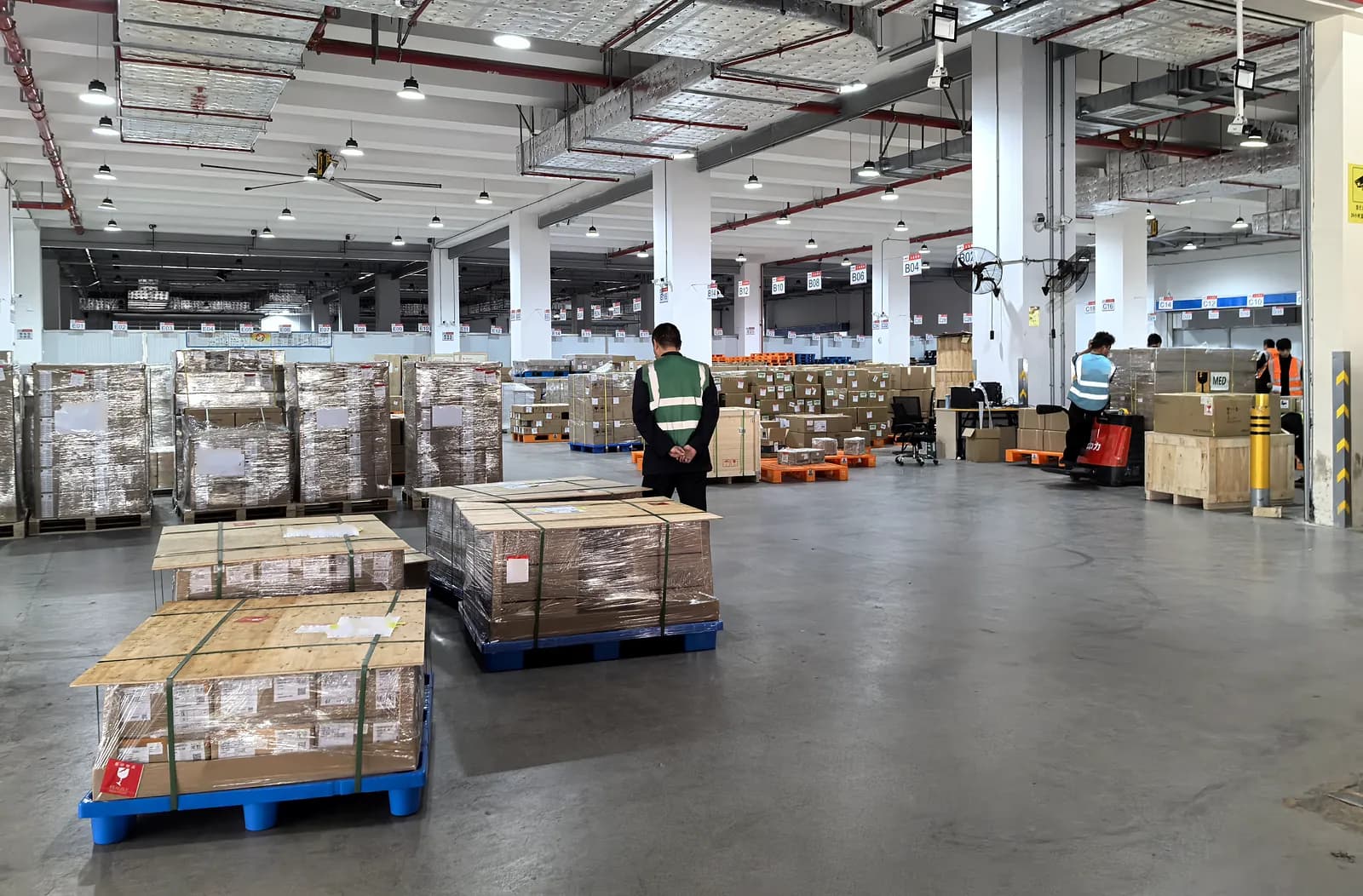
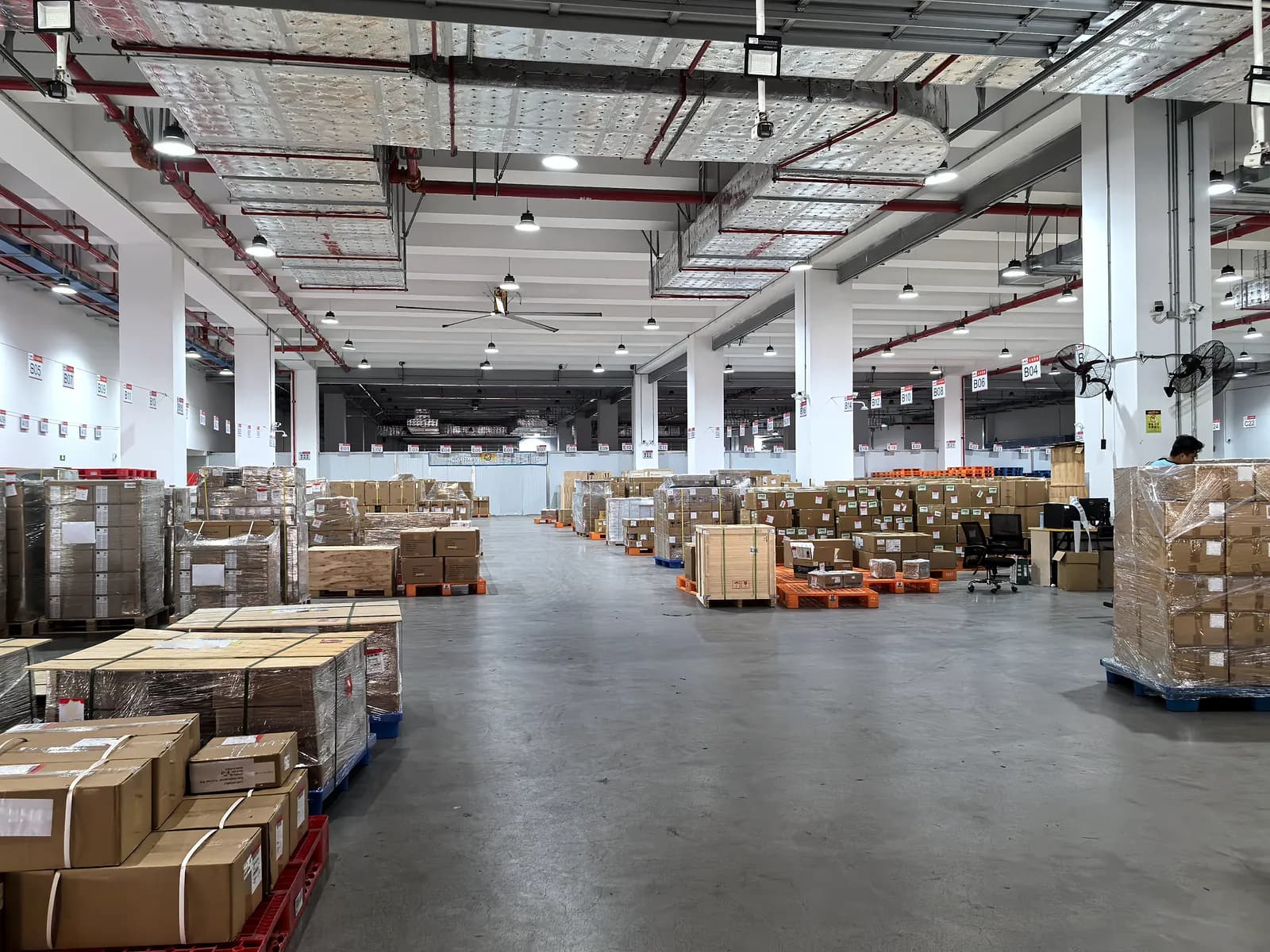
Suppliers can deliver to our Shenzhen warehouse, where we receive and check each delivery, repack and relabel where needed, and consolidate orders from several factories into one shipment. Carton labels are prepared and cartons marked before dispatch, and cartons are stretch-wrapped and strapped onto pallets. For Amazon FBA shipments, send us your shipment labels and we label and palletise the cartons in Shenzhen. Handling charges are confirmed with your quote.
FAQ
Do I need pallets for air freight from China?
Not always, but air consolidations are usually palletised so cartons are handled by forklift and travel as one unit. The pallet's weight and the full height of the load count towards the chargeable weight, so stack cartons flush and keep the load compact. Express parcels travel as single cartons.
Do plywood crates need an ISPM 15 stamp?
No. ISPM 15 covers packaging made from raw wood. Packaging made wholly of processed wood such as plywood, particle board or oriented strand board, and wood 6 mm thick or less, is not covered. Solid-wood pallets, crates and dunnage need treatment and the IPPC mark.
What should a shipping mark include?
The order or brand mark, the destination, the carton number out of the total (such as 3/50), gross and net weight, dimensions and the country of origin, plus handling marks where needed. The numbers must match the packing list.
Can you repack my supplier's cartons before shipping?
Yes. At our warehouse we check each delivery, repack and relabel where needed and consolidate orders from several suppliers into one shipment. Tell us what you need when you ask for a quote; handling charges are confirmed with it.
Sources
Services and routes in this article
Send us the details — you'll get a confirmed door-to-door quote and a dedicated coordinator.
Read next
All insights
How to Ship to Amazon FBA from China: Step by Step
From the Seller Central shipment plan to box labels, carton limits, air or sea by marketplace, customs and appointments: how FBA first-leg shipping works.
Chinese New Year 2027 Shipping: Deadlines and Planning
Chinese New Year falls on 6 February 2027. Factories close for one to four weeks and space tightens before the holiday. A month-by-month plan for shippers.
Australia Import Duty and GST on Goods from China
What Australian duty and 10% GST add to goods from China, how a ChAFTA certificate of origin removes most duty, and what changes above A$1,000.